

![[object Object]](/media/2026/05/Blockchain-Gaming.webp?w=1920)
Video games have long featured robust digital economies. For decades, players have dedicated countless hours to collecting rare items, optimizing character builds, and trading assets within virtual marketplaces. However, a fundamental limitation has always bound these economies: the game developer completely controls the infrastructure.
Blockchain gaming completely transforms this dynamic by shifting ownership from central corporate servers to a decentralized, public ledger. If you have run into industry terms like crypto games, NFT games, Web3 gaming, or Play-to-Earn (P2E), you are witnessing the birth of a new paradigm in digital entertainment.
This comprehensive, search-optimized guide breaks down the core mechanics of blockchain gaming, details its technical foundations, weighs its challenges, and maps out where this multi-billion-dollar industry is heading next.
What Is a Blockchain Game?
A blockchain game (often referred to as a Web3 game or crypto game) is any video game that integrates distributed ledger technology into its architecture. This technology is primarily used to manage the game’s economy, track asset ownership, handle state transitions, or verify player achievements.
Unlike traditional gaming ecosystems where all data resides on a siloed, proprietary database owned by the publisher, blockchain games leverage decentralized networks to guarantee transparency, data immutability, and authentic digital scarcity.
Deconstructing the Terminology
The industry frequently uses several terms interchangeably, though they emphasize slightly different aspects of the technology:
- Crypto Games: Titles that fundamentally integrate native cryptocurrencies for in-game purchases, reward structures, and utility.
- NFT Games: Games that utilize Non-Fungible Tokens to represent distinct, unique in-game assets like weapons, armor, characters, or virtual real estate.
- Web3 Games: A broader, umbrella classification for games built using decentralized internet principles, self-custody wallets, and community-driven governance.
- Metaverse Games: Immersive, persistent virtual worlds powered by underlying blockchain economies where users can socialize, create, and monetize digital content.
Core Differences: Traditional vs. Blockchain Gaming
To understand why this shift matters to search engines, players, and developers alike, it is critical to compare the operational blueprints of traditional gaming against decentralized models:
| Feature | Traditional Gaming (Web2) | Blockchain Gaming (Web3) |
|---|---|---|
| Asset Ownership | Custodial (Licensed to the player; remains corporate property) | Non-Custodial (True digital ownership secured via cryptography) |
| Database Structure | Centralized server (Siloed and prone to single points of failure) | Distributed ledger (Public, transparent, and immutable) |
| Economy Type | Closed-loop (In-game currency cannot legally be converted to cash) | Open-market (Tokens and NFTs trade freely on external decentralized exchanges) |
| Interoperability | Non-existent (Items are strictly bound to a single game ecosystem) | High potential (Cross-game asset compatibility via shared protocols) |
| Governance | Top-down (Publishers make all balance and structural updates) | Decentralized (Governed by players and investors via DAOs and tokens) |
The Technical Architecture: How It Works Behind the Scenes
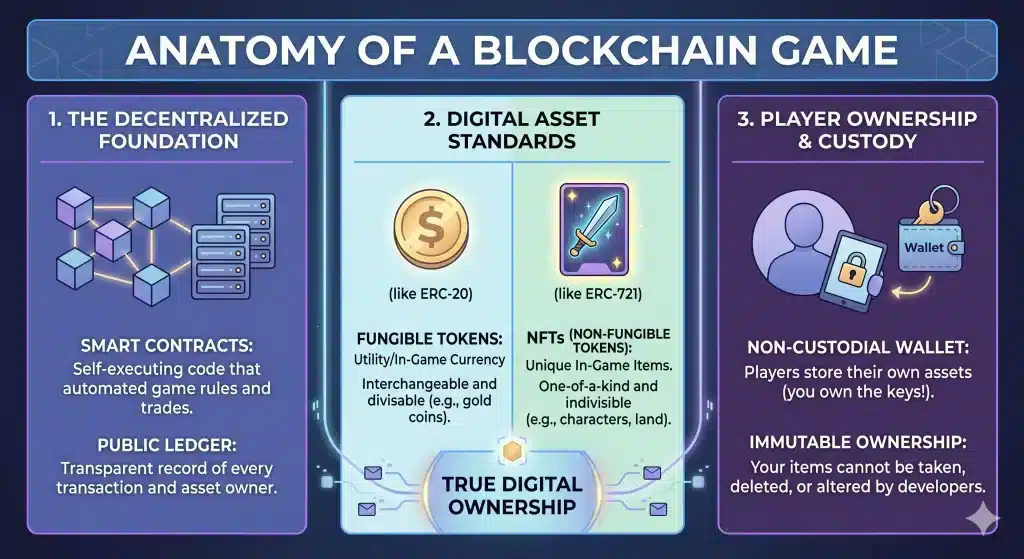
The core value proposition of Web3 gaming relies heavily on two primary technological pillars: smart contracts and token standards. The infographic below breaks down how smart contracts, tokens, and wallets interact to create a decentralized gaming ecosystem:
Smart Contracts as Automated Arbiters
A smart contract is a self-executing cryptographic program deployed directly onto a blockchain network. It automatically triggers specific actions when predetermined parameters are met.
In a gaming context, smart contracts remove the need for an intermediary trusted third party. When you defeat a boss, win a competitive match, or trade an item with another player, a smart contract evaluates the conditions and updates the ledger autonomously. Because the underlying code is public and verified, developers cannot arbitrarily revoke your rewards or alter trade agreements retroactively.
Token Ecosystems: Fungible vs. Non-Fungible
Web3 architectures rely on two distinct types of digital token standards:
- Fungible Tokens (Utility/Governance Tokens): These are interchangeable digital assets, built on standards like Ethereum's ERC-20 or Solana's SPL. They function as the internal currency of the game. They are used to purchase consumables, pay for entry fees, or participate in ecosystem governance via a Decentralized Autonomous Organization (DAO).
- Non-Fungible Tokens (NFTs): Built on standards like ERC-721 or ERC-1155, NFTs represent completely unique, individual assets. If you unlock a legendary sword, that sword is minted as a distinct NFT containing specific metadata (e.g., weapon stats, durability, historical ownership record). No two NFTs are identical, creating verifiable digital scarcity.
Primary Benefits of Blockchain Integration
True Digital Ownership and Self-Custody
In a standard Web2 game, buying a virtual item is legally equivalent to renting a temporary license. If the studio goes bankrupt, experiences server failure, or decides to ban your account, your digital collection disappears instantly.
Blockchain gaming introduces genuine self-custody. Because your earned items live as tokens inside your personal cryptographic wallet, you retain ownership of those assets completely independent of whether the game studio remains in business.
From Play-to-Earn (P2E) to Play-and-Earn
The early iteration of Web3 gaming popularized Play-to-Earn (P2E), a framework where players generated continuous token streams through repetitive tasks. The industry has since pivoted to Play-and-Earn (P2E 2.0).
This updated philosophy focuses heavily on delivering fun, premium gameplay loops while seamlessly embedding economic upside. Players receive real-world value as a secondary reward for skill and dedication, rather than treating the game like a digital factory job.
Interoperability and Cross-Game Portability
Because tokens exist on open, public networks, they are inherently composable. In a fully realized Web3 ecosystem, a character skin earned in an open-world RPG could theoretically be read by an entirely separate racing game developed by a different studio, provided both applications are built to recognize the same underlying token metadata.
Current Bottlenecks and Market Hurdles
Despite its immense potential, blockchain gaming faces significant technical and cultural challenges that it must solve before achieving mainstream market dominance.
- Friction in the Onboarding Process: To play a traditional game, a user simply clicks "Download." A blockchain game frequently requires setting up a non-custodial software wallet (like MetaMask or Phantom), managing private seed phrases, purchasing native gas tokens (like ETH or SOL), and interacting with network bridges.
- Scalability Constraints and Gas Fees: Popular layer-1 blockchains can become intensely congested during high-traffic periods. This network congestion results in slow transaction processing speeds and high network transaction fees (gas fees), which can destroy the financial viability of micro-transactions.
- The "Fun-First" Deficit: Many early Web3 titles focused entirely on tokenomics and financial speculation while ignoring graphic fidelity, narrative depth, and engaging gameplay loops. This imbalance alienated mainstream gamers who prioritize pure entertainment value over financial returns.
- Security Vulnerabilities: Smart contracts and cross-chain token bridges are frequent targets for highly sophisticated exploits and hacks. If a bridge is compromised, millions of dollars in player assets can be drained instantaneously.
Real-World Case Studies: The Pioneer Ecosystems
To see how these concepts function in practice, look at the foundational projects that have defined the landscape so far:
- Axie Infinity: Developed by Sky Mavis, this title proved the viability of the P2E model on a massive scale. Players collect, breed, and battle fantasy creatures called "Axies." The game features its own dedicated Ethereum sidechain, known as Ronin, explicitly designed to eliminate high transaction fees.
- The Sandbox: A vast decentralized metaverse world where users use native utility tokens ($SAND) to buy virtual plots of land (LAND). Owners can develop custom mini-games, monetize interactive digital experiences, and trade voxel-style items on an open marketplace.
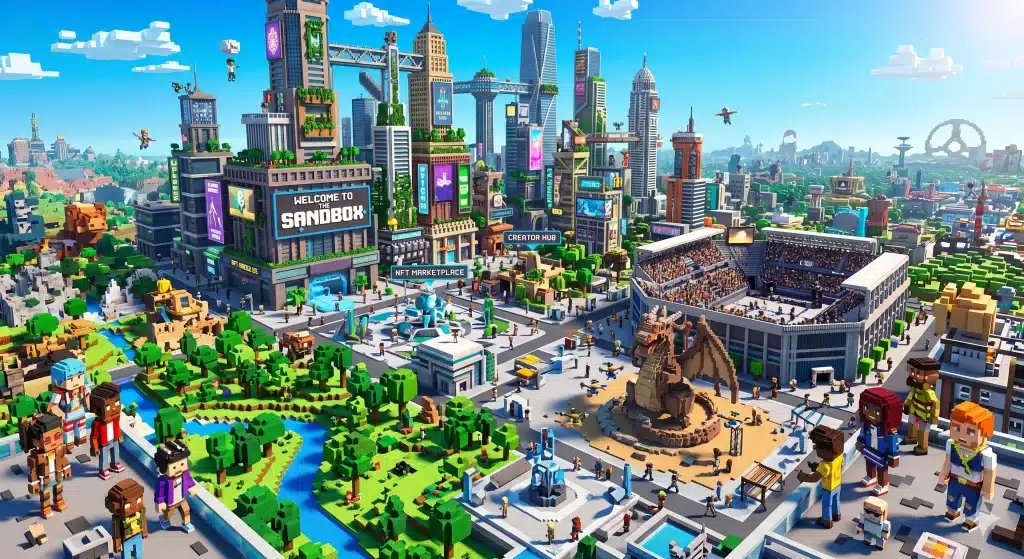
- Decentraland: An early, completely decentralized virtual world governed entirely by its community via a DAO. Players purchase land, build architectural structures, and host virtual events ranging from corporate conferences to digital music concerts.
The Evolution of the Market: What Lies Ahead?
The future growth of Web3 gaming relies heavily on structural invisibility. This shift is deeply tied to broader crypto trends, where the most successful next-generation Web3 studios are building titles that mask technical complexities behind polished user interfaces.
Future players will likely onboard using simple social media logins, while custodial wallets are automatically generated quietly in the background. Gas fees will be subsidized by developers via highly efficient Layer-2 scaling networks (like Immutable X or Arbitrum).
When games prioritize compelling storylines, immersive graphics, and excellent combat mechanics—while letting the blockchain operate silently as an underlying security layer—the line between "traditional gaming" and "blockchain gaming" will disappear entirely.
Frequently Asked Questions (FAQ)
Is it expensive to start playing blockchain games?
It depends entirely on the game's economic model. Many modern Web3 titles adopt a hybrid free-to-play model where you can jump in for free, while premium items, faster progression systems, and economic rewards require purchasing specific NFTs.
What is a crypto wallet, and why do I need one?
A crypto wallet is a digital application that stores the private cryptographic keys used to sign transactions and verify ownership of assets on the blockchain. It acts as your universal identity and inventory across the decentralized web.
Can you lose money in Play-and-Earn games?
Yes. Tokens and NFTs are highly speculative assets subject to intense market volatility. If the demand for a game falls, the market value of its native tokens and virtual items can drop drastically. You should never purchase digital assets with money you cannot afford to lose.
How do Layer-2 networks help Web3 gaming?
Layer-2 networks are secondary frameworks built on top of an existing primary blockchain (Layer-1). They bundle thousands of game transactions together and process them off-chain before settling them back on the main network, dramatically lowering fees and increasing transaction speeds.